Skip to content


How to Sharpen Vine Charcoal

Rather Simple, Isn’t It?

Yes, I know this sounds like a simple, basic thing, but for those of us who don’t have someone at hand to show us how it’s done, understanding how to sharpen vine or willow charcoal can be quite confusing. When I first began considering the Bargue Drawing Course, I was surprised at how difficult it was to track down this information. In the end, I don’t remember exactly where I got hold of the proper info, but it took me a long time. That said, I’m hoping this post will be of use to some poor, struggling artist somewhere.

Use the Right Materials
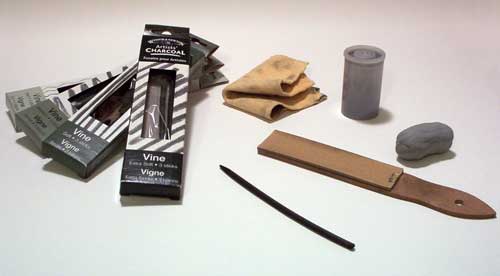
Vine Charcoal Drawing Supplies - clockwise from left: vine charcoal in various densities, chamois, film canister for storing charcoal dust, sharpening block, vine charcoal stick

Vine Charcoal Drawing Supplies - clockwise from left: vine charcoal in various densities, chamois, film canister for storing charcoal dust, kneaded eraser, sharpening block, vine charcoal stick

For the most optimal conditions with which to do a drawing in vine charcoal, it’s important to have a few key supplies. First and foremost, you’ll obviously need some vine charcoal, which can be found at any art supply or craft store. It comes in a range of densities, from hard to very soft, and is relatively inexpensive. It’s best to purchase the range of densities and experiment a bit with it until you find the strengths and weaknesses of each one. The softer the charcoal, for example, the easier it is to erase. If you’re like me and make lots of mistakes you may want to try this out first. The only downside to the softer vine sticks is that they dull rapidly and require a lot of sharpening, which can be annoying when you’re in the middle of a drawing and prefer to keep moving.

For erasing, or lifting charcoal off the paper, a combination of a kneaded eraser and a piece of chamois leather works very well. You can find a chamois in the automotive section of most grocery and/or department stores (they are commonly used for washing vehicles). You can cut pieces off it as you have need – a piece approximately 6″ square will be sufficient.

For the actual sharpening of the charcoal sticks, you will need a sandpaper sharpening block which, again, can be found at most art supply or craft stores. Essentially, it’s a small wooden block with strips of sandpaper stapled to it. As each sheet of sandpaper gets saturated with charcoal dust, you can just tear it off and throw it away. You won’t need to do this too often, though, with vine charcoal, as it tends to fall off the sandpaper rather than saturate it. This leads me to another key supply – an empty film canister (or similar container) to store charcoal dust in. Why save the dust? It can be very useful for doing subtractive drawings, which involve laying down a rubbing of charcoal dust on paper, erasing out highlights, and darkening shadows. The best way I’ve found to collect the dust is to sharpen your charcoal sticks over a piece of vellum or tracing paper (you’ll need a very smooth surface). When you’re done with your drawing session, just roll up the paper a bit and funnel it into your container for later use. By the way, the going rate for a container of powdered charcoal is about $9.00, so you’ll be saving a good deal of money if you follow this method. Smart…

The Process
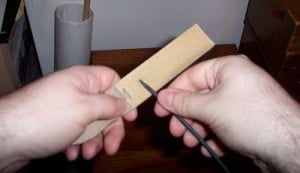
place the charcoal on the sharpening block at a 45-degree angle

place the charcoal on the block at a 45-degree angle

roll the charcoal while rubbing across the block

roll the charcoal while rubbing across the block

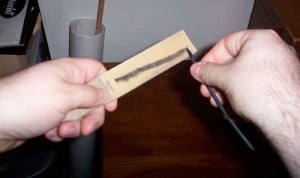
Ok – you’ve got your supplies and a healthy dose of enthusiasm. Now you’re ready to start drawing! To sharpen a stick of vine charcoal, you’ll want to hold your sandpaper sharpening block in your weak hand and the charcoal in your dominant hand. Place one of the ends of the charcoal stick on your sharpening block at a 45-degree (or greater) angle. Push the charcoal away from you along the sandpaper, rolling it slightly between your index finger and thumb to ensure a nice round, even point. The point should be a long taper and not a short stubby one. That’s about it – easy!

Has the information at the Home-Based Atelier helped you? Consider donating to help offset the costs of maintaining this website.


Posted in Drawing, General Information.


6 Responses

Stay in touch with the conversation, subscribe to the RSS feed for comments on this post.

  1. Valerie Malley says

    Hello Daniel: If you are receiving this again it’s because I hit some button and something came up on my computer and seemed to erase my first response. However, here goes. I want to express my thanks and appreciation to you for taking the time for sharing your experiences with the Barque method and drawing in general. I have the book but got waylaid when I realized the necessity to enlarge the pictures in order to benefit from the drawing process. I need to find a place to do this enlarging without my having to ‘teach’ them what to do. I have Photoshop Elements 6, but need to learn the system in order to do the sizing myself. So both are leaving me feeling a little overwhelmed, though I appreciate I’ll have to take the bull by the horns one day. Appreciated the instruction on sharpening vine charcoal, wouldn’t have thought of it. Anyway, again thanks. Your comments are clear and readable and much appreciated.

  2. admin says

    Hi Valerie,

    Glad you’ve found the site helpful. Yes, if you don’t already know how to do it, resizing the plates can either be difficult or expensive. My advice would be to only do one or two at a time since it will take you some time to draw them. Do you have a scanner? At the very least, you could scan one or two of the subjects at a time and just print them out at 8.5″ x 11″. This would work for the first couple of plates but you would have to find a solution upon arriving at the larger plates. Being a graphic designer, I sometimes forget about the challenge that this can pose to others…

    Just remember – don’t let this hold you back! Keep moving or you won’t achieve the benefits of using the course or realize the dreams that made you acquire it in the first place. You can overcome this!

    - Dan

  3. Susanne says

    Guten Tag Dan, I will be a frequent reader on your blog. It is very instructive and hopefully also a source of motivation to you in order to continue consistently on the path you started. Although I would much rather see new Hanawalt Originals soon – instead of boring copies of old drawings, I have no doubt that you chose the right way to move your paintings to a new level. Especially in the figurative realm, which I have always been most exited about and most admired your talent. My respects and best wishes! Susanne

  4. admin says

    Willkommen, Susanne! Ha – so you don’t like my copies of boring old drawings, eh? Well, just remember – you can’t get anywhere by standing still… How many times have I told you – practice, practice, PRACTICE! :)

    Don’t worry – you’ll see some Hanawalt originals soon. My art league reconvenes in September and I’d better have something to show for the summer months. Thanks for your constant support and encouragement – you’ll always be one of my most respected critics. I hope you continue with your mural. I expect to see some updates soon!

    - Dan

  5. Rene says

    This is a very helpful blog for me because I am going to start my own drawing course at home on the next monday and I use Bargue plates, too.

    I am looking forward to your next drawings.

  6. admin says

    Hi Rene – all the best to you in your drawing course. Let me know if there are any other topics that you would appreciate hearing about. Thanks!


Some HTML is OK

or, reply to this post via trackback.